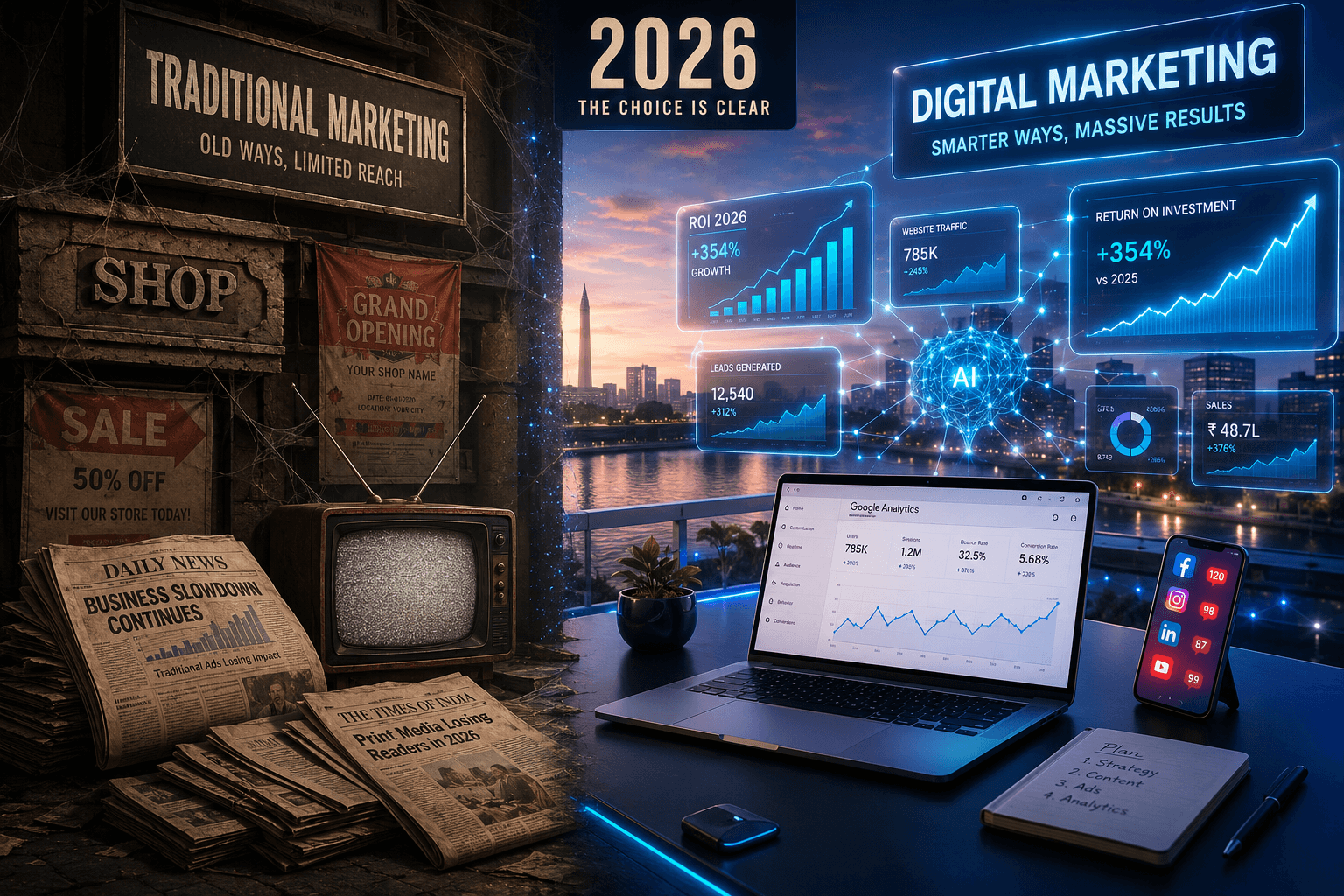
Marketing budgets are under the microscope in 2026. For decades, businesses in Ahmedabad—and across India—relied heavily on traditional marketing: print ads, billboards, TV commercials, and radio jingles. But the digital revolution has fundamentally shifted the tectonic plates of consumer behavior. Digital Marketing vs Traditional Marketing 2026: 10 Data-Driven Reasons Digital Wins Every Time
In 2026, global digital advertising spending is projected to surpass $750 billion, while traditional TV ad spend is stagnating at pre-pandemic levels. Meanwhile, India now boasts over 900 million active internet users, with 74% accessing the web via mobile. As a Freelance Web Designer & Digital Marketing expert based in Ahmedabad, I, Rushin Parmar, have witnessed first-hand how businesses that pivot to digital outperform their traditional-only competitors by staggering margins.
This blog is not just an opinion; it is a data-driven comparison of why digital marketing wins in 2026. If you are a business owner in Gujarat deciding where to place your next marketing rupee, these 10 data-backed points will make your decision crystal clear.
Point 1: Unmatched Hyper-Targeting Capabilities
Traditional Marketing Shouts; Digital Marketing Whisper-Converses with the Right Audience.
Traditional marketing is a “scattergun” approach. A billboard on SG Highway or a print ad in a Gujarat newspaper is seen by thousands of people who have zero interest in your product. In 2026, consumers ignore generic noise. Digital marketing flips this script. Platforms like Google Ads and Meta (Facebook/Instagram) allow businesses to target users based on age, location (down to a 5km radius in Ahmedabad), interests, online behavior, income level, and even life events.
For instance, if you sell premium e-commerce solutions for jewelry, traditional ads waste money showing your ad to students. Digital ads ensure your message is shown only to high-income individuals who have searched for “buy jewelry online” or visited competitor sites. In 2026, custom audiences and lookalike modeling are so advanced that your ad spend efficiency (ROAS) is 5x to 10x higher. For a local Ahmedabad client recently, we reduced their cost-per-lead from ₹2,500 to just ₹300 by switching from newspaper ads to hyper-localized Facebook targeting.
Point 2: Real-Time Analytics vs. Blind Faith
You Can’t Manage What You Can’t Measure (The Analytics Advantage).
When you run a traditional campaign—say, a hoarding or a magazine insert—how do you track success? You rely on vague estimates, “brand recall surveys,” or complicated QR codes that rarely get scanned. In 2026, this is business suicide. Digital marketing provides a God’s-eye view of your campaign’s performance.
Tools like Google Analytics 4 and Meta Business Suite show you exactly how many people saw your ad (Impressions), how many interacted (Engagement), how many clicked through to your website (Traffic), and—most importantly—how many actually called you or made a purchase (Conversions). This real-time data allows marketers, like our team at Rushin Parmar, to make informed decisions on the fly. If a headline isn’t working, we change it within an hour. Traditional marketing is a sunk cost; you pay for it and hope for the best. Digital marketing is an investment; you analyze the returns daily and optimize for maximum output.
Point 3: Superior Cost-Effectiveness for SMEs
Digital Marketing Delivers 5x More Leads Per Rupee Spent.
In 2026, Small and Medium Enterprises (SMEs) in India are particularly sensitive to marketing budgets. A 30-second TV slot during a prime-time show in India can cost upwards of ₹5 lakhs to ₹10 lakhs for a single airing. Local newspaper ads cost ₹5,000 to ₹50,000 per edition but reach an aging demographic.
Digital marketing offers a democratized playing field. A well-optimized SEO (Search Engine Optimization) campaign can generate continuous organic traffic for months with a single upfront investment in content. Pay-Per-Click (PPC) campaigns allow you to start with just ₹500 a day. HubSpot data shows that digital marketing generates roughly 5x the number of leads for small-to-medium businesses compared to outbound marketing methods, while costing 30% less. For business owners in Ahmedabad looking to maximize their runway, the cost-efficiency of digital—combined with measurable results—makes it the undisputed heavyweight champion.
Point 4: The Power of Personalization (AI-Driven Engagement)
Generic Greetings Are Out; Dynamic Personalization Is In.
In the age of AI, consumers expect to be recognized. Walking into a shop where the owner knows your name is a great feeling—digital marketing replicates that feeling at scale. In 2026, AI-driven tools analyze user behavior to deliver dynamic content.
Imagine a visitor lands on your WordPress E-Commerce website (developed by Rushin Parmar) looking for “Men’s Running Shoes.” They leave without buying. Digital marketing retargeting remembers this and serves them an ad showcasing those exact shoes with a 10% discount, customized to their size preferences. Traditional marketing can’t do this. Email marketing automation sends personalized birthday greetings or product recommendations based on purchase history, boasting open rates 50% higher than generic blasts. Personalization increases consumer engagement by 60%, making digital interactions far more potent than a static hoarding that treats every passerby identically.
Point 5: Global Reach with Hyperlocal Impact
Sell to the World While Dominating Your Local Market.
One of the greatest fallacies in traditional marketing is the local vs. global trap. If you run a print ad in the Times of India Ahmedabad edition, you are limited to that geography. Conversely, a national TV ad reaches across India but is wildly expensive and irrelevant to specific regional nuances.
Digital marketing bridges this gap perfectly. A company can use GEO-targeting to show different ads to users in Ahmedabad, Mumbai, and New York simultaneously. At the same time, by using local SEO tactics—optimizing Google My Business and using locally relevant keywords like “Web Designer in Ahmedabad”—we ensure that a business appears on top of local search results. In 2026, 46% of all Google searches have local intent. Digital marketing allows you to dominate the local “near me” searches while simultaneously opening up your e-commerce website to international traffic without needing a physical store there.
Point 6: Rapid Adaptability and Campaign Agility
Pivot in Minutes, Not Months.
The world moves fast. A sudden economic shift, a viral meme, or a competitor’s flash sale can change the market overnight. If you rely on traditional marketing, your messaging is set in stone—literally, if you printed it. To change a billboard costs thousands; to change a TV commercial requires a massive reshoot.
Digital marketing is inherently agile. In 2026, if we see a campaign isn’t working, we pause it instantly. If a specific keyword is trending, we create a blog post or an ad variation in 30 minutes and push it live. This agility means businesses can react to weather changes (selling raincoats), geopolitical events, or sudden social media trends in real-time. For brands in Ahmedabad, this ensures they remain culturally relevant and current, while traditional brands often look dated and out-of-touch.
Point 7: Enhanced Engagement and Interactivity
Headline: Passive Viewers vs. Active Participants.
Traditional marketing is a monologue. A TV commercial broadcasts a message, and the consumer passively consumes it (or more often, scrolls their phone during the break). There is no two-way street. In 2026, consumers crave interaction.
Digital marketing turns prospects into participants. Instagram polls, TikTok/Reel challenges, YouTube live streams, and LinkedIn comment sections foster a community around the brand. People don’t just see your logo; they talk to you. Responding to a comment on a post builds trust far more effectively than a static advertisement. Furthermore, User-Generated Content (UGC) serves as organic social proof. When a customer tags your brand on Instagram, it acts as a recommendation to their entire network. This engagement loop is impossible to replicate with a newspaper insert.
Point 8: Mobile-First Consumer Behavior
India Shops, Learns, and Connects on Mobile.
By 2026, mobile devices account for over 70% of all web traffic globally, and in India, the figure is closer to 80%. Let’s be honest—when was the last time you read a newspaper cover-to-cover? Conversely, how many times did you check your WhatsApp or Instagram today?
Traditional marketing—magazines, billboards, TV—fails to engage the “mobile hand” that is always connected. Digital marketing is engineered for the thumb. From mobile-responsive websites to SMS marketing and app-based retargeting, digital strategies are built for the 6-inch screen. Google’s mobile-first indexing means that if your digital presence isn’t optimized for mobile, your SEO rankings plummet. At Rushin Parmar, we ensure every website we design and every social media campaign we run is meticulously optimized for mobile viewing, ensuring you capture the modern consumer where they live: on their smartphone.
Point 9: Superior Lead Generation Mechanisms
Traditional Marketing Generates “Noise”; Digital Marketing Generates “Leads.”
The ultimate goal of marketing isn’t just awareness—it’s conversions. Traditional marketing struggles to convert. Even if someone is interested in a TV ad, they have to remember the phone number or visit a physical store. In 2026, the buyer’s journey has zero friction.
Digital marketing gives you powerful tools to capture leads: Opt-in pop-ups, downloadable PDFs, “Book a Consultation” forms, and 24/7 chatbots. When a user visits a website designed by us, we capture their email or WhatsApp number in exchange for a free consultation. Once we have the contact, automated follow-ups nurture that lead until they are ready to buy. This inbound methodology generates leads that are 3x more likely to convert because they raised their hand first. Conversely, cold calling and traditional advertising often yield a 1% response rate, which is abysmal compared to the 10%+ conversion rates we see in targeted digital funnels.
Point 10: Future-Proofing with AI, Automation, and SEO
Digital Marketing Learns and Evolves; Traditional Marketing Stagnates.
Perhaps the most significant advantage in 2026 is the integration of Artificial Intelligence. Traditional marketing doesn’t get smarter over time; it’s static. Digital marketing, however, is driven by algorithms that learn and optimize themselves.
AI platforms analyze past performance to predict future outcomes—automatically suggesting budget adjustments or the best time to send an email. SEO is the gift that keeps on giving. A well-optimized blog post written today continues to generate organic traffic for years. It compounds. Traditional advertising ends the second the campaign budget runs out. Furthermore, as search engines evolve with AI, zero-click searches are becoming the norm. To rank #1 in search results, businesses need the authority and trust that only consistent digital marketing (SEO, Social Signals, and Content) can provide. Investing in digital is investing in a scalable, futuristic infrastructure for your business.
Conclusion: Digital Marketing vs Traditional Marketing
As we navigate the marketing landscape of 2026, the data is unequivocal: Digital Marketing is not just an alternative to Traditional Marketing; it is its superior replacement. While traditional methods have their place in very specific, hyper-local, legacy-based branding, the vast majority of reach, engagement, and concrete Return on Investment comes from digital channels.
The “why” is simple: targeting, measurability, cost-effectiveness, and adaptability. For businesses in Ahmedabad and across Gujarat, the growth hack of the decade is moving your budget from static media to dynamic, data-driven digital strategies.
The world has moved to mobile, and your marketing strategy must follow suit. It is time to stop shouting into the void with billboards and start having meaningful conversations online.
Let’s build your digital empire together.
Whether you need a lightning-fast E-Commerce website, a complete WordPress development overhaul, or a robust SEO strategy—we build it all.